Moving to Dubai
Moving to Dubai,
well prepared.
Taxes, visa and everyday life: what really matters when moving to Dubai, explained clearly by people who live here themselves.
Moving to Dubai
The move pays off,
if you plan it properly.
Dubai has attracted German-speaking expats for years: no income tax, high safety, modern infrastructure and a large international community. But that only holds true if your visa, tax situation and everyday logistics are planned properly from the start. Otherwise a fresh start can quickly turn into an expensive misunderstanding.
Most of our clients don’t move to Dubai as private individuals, but through their own company. That is legally the most stable and, for most people, also the most economically sound route to residency. More on that under "Requirements" below.
The best approach is a clean preparation, which saves money and time in the end and above all needs a clear intention. We support a bold step, but just as strongly recommend a financial reserve and a vision for where the move is heading.
Requirements
Three routes to
residency in Dubai
A residence visa is the basic requirement to live in Dubai long term. There are essentially three routes to get one, and they differ significantly in effort, cost and economic independence.
Employment
An employer in Dubai applies for your visa. The simplest route, but you are tied to that employer and have no economic footing of your own.
Property purchase
For sole ownership there is currently no fixed minimum for the 2 year investor visa, for joint ownership a minimum share of AED 400'000 per person applies. For the long term 10 year visa the threshold is AED 2'000'000. No automatic right to work locally.
Company formation
Your own free zone or mainland company usually allows you to apply for a residence visa, for you and, depending on the structure, your family too. It also creates an economic footing of your own.
Costs
What does the
move really cost?
Besides the one-time costs for the visa and the move itself, ongoing living costs matter most. They depend heavily on the neighbourhood and lifestyle you choose. For many expats, the income tax they no longer pay more than offsets higher rent in sought-after areas.
Life in Dubai
Everyday life:
housing, family, safety
Dubai regularly ranks among the safest large cities in the world in international rankings, and that shapes everyday life noticeably, especially for families.
Housing
It mostly comes down to your priority: city life, quiet, the beach or a particular lifestyle. Dubai's communities differ a lot, and the experience of living in them differs accordingly. We advise on this individually in the initial consultation.
Family & schools
Family sponsoring for spouses and children is possible. The standard of education at international schools is excellent, but costs vary widely and should be checked carefully beforehand.
Health insurance
Health insurance is a legal requirement. We don't compare individual policies in detail, but share our own experience and connect you with the right partners if needed.
Community
One of the largest German-speaking communities in the Middle East, from business networks to private meetups. What matters for everyday life: where you work, where your children go to school and what budget you have, since that is where you spend most of your time.
Six neighbourhoods at a glance, to give you a first sense of which area could fit your everyday life. The right choice always depends on budget, family situation and lifestyle, we advise on this individually in the initial consultation.
Downtown Dubai
Central and urban, right by the Burj Khalifa and Dubai Mall. High price level, but short distances to business districts. Fits people who prefer a dense city lifestyle over a quiet setting.
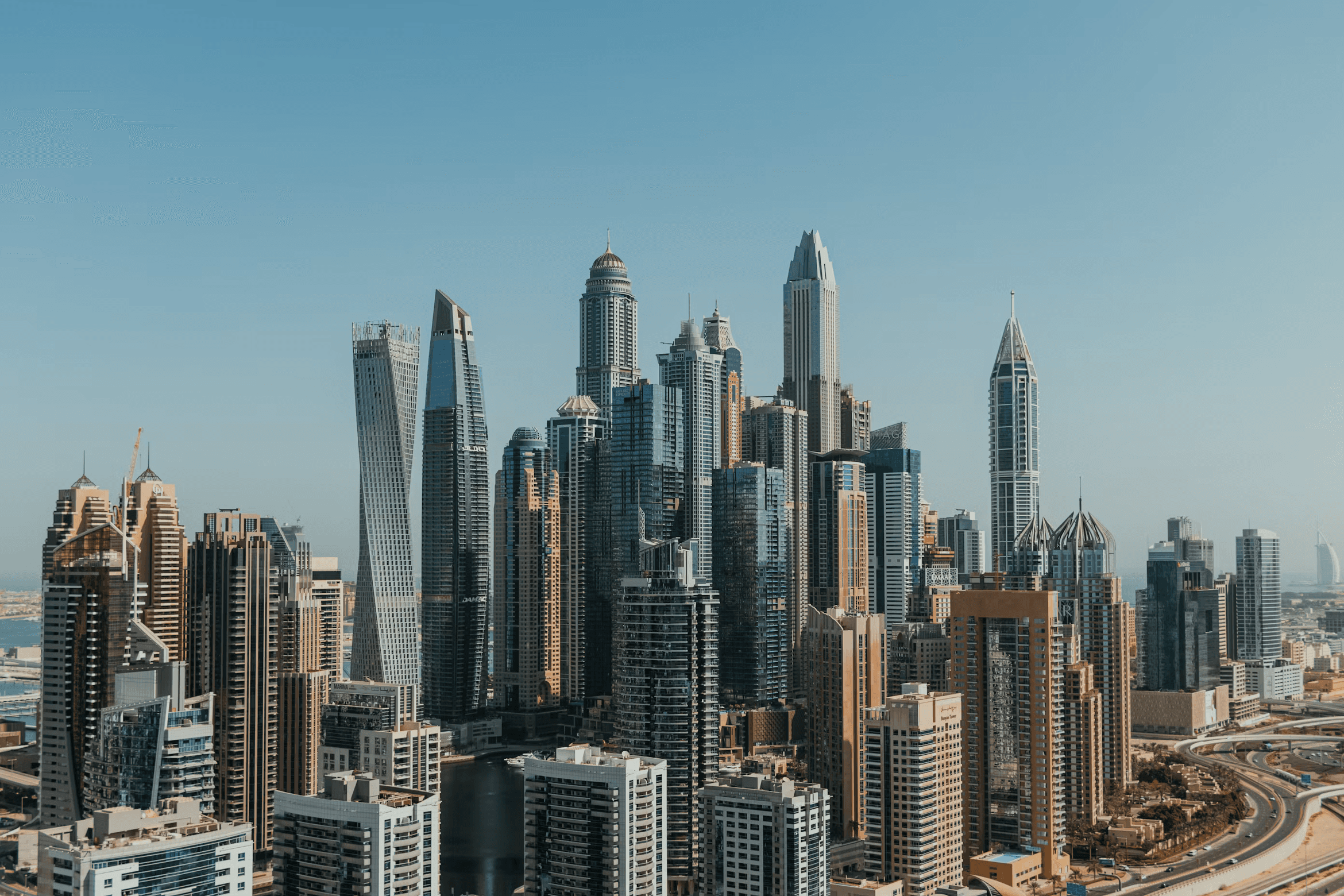
Dubai Marina
Waterfront living, many international expats, restaurants and the beach within walking distance. One of the liveliest areas, and priced accordingly in the upper mid range.
Jumeirah Village Circle
Centrally located between the major hubs and noticeably more accessible on price. Popular with young families and professionals, a good entry point for a first move to Dubai.
Dubai Hills Estate
Villas and townhouses set in green surroundings, quiet and family oriented, with several good schools nearby. A car is practically a requirement here.
Palm Jumeirah
Beachfront and the luxury segment, the highest price level on this list. More suited to clients with a larger budget than to a first move.
Business Bay
Right next to Downtown, home to many company headquarters and free zone offices. Interesting for entrepreneurs who want to live close to their own company.
These are only six of many more neighbourhoods worth considering for a move. We recommend looking at the options in detail, ideally together with us in the initial consultation.
Taxes
A clean tax
exit
Tax questions around leaving your home country are highly individual. Here are the key principles you should know before looking into this further.
These questions depend heavily on your personal situation: assets, citizenship, family status, existing company structures. We are not a tax advisory firm and therefore do not discuss individual tax situations in detail. What we do: name the relevant topics and connect you with the right experts if needed.
Book a free initial callFrequently asked questions
Yes, there is no general barrier to immigration. You do need a valid residence visa though, tied to employment, a property purchase or your own company.
No, not strictly. For most of our clients it is the most sensible route though, because it creates residency and an economic footing in one step instead of two separate processes.
From the initial consultation to a finished Emirates ID, most of our clients should plan for 4 to 8 weeks, depending on licence type and appointment availability on the ground.
Yes, spouses and children can be included through family sponsoring. The exact requirements depend on your own visa type.
For tax purposes, exit is generally only recognised once your actual centre of life has moved abroad. The exact requirements differ by country and individual situation, we go through this in detail in the initial consultation.